Blog

  • 20 Symptoms that can Indicate Eye Problems

    20 Symptoms that can Indicate Eye Problems

    Our eyes are vital to our daily lives, and noticing changes in them can sometimes indicate ryantheotter12 abigail lutz nude Ryantheotter12eye problems. Understanding the symptoms of eye issues is crucial, as early intervention can prevent more serious damage. If you are experiencing any of the following symptoms, it may be a sign of an underlying issue. Recognising these symptoms and seeking prompt attention can help protect your vision and overall eye health.

    1. Blurred Vision: What Does It Mean?

    Blurred vision is one of the most common symptoms of eye problems. It can happen suddenly or develop over time. It might indicate a refractive error such as nearsightedness or farsightedness, but it can also be a sign of more severe issues, such as cataracts or glaucoma. 

    2. Red Eyes: Is It Just Fatigue or Something More?

    Red eyes can be a symptom of several eye problems. Common causes of eye problem​s include eyestrain, allergies, or lack of sleep. However, red eyes can also indicate more serious conditions such as conjunctivitis, an eye infection, or a blocked tear duct.

    3. Eye Pain: Should You Be Concerned?

    Eye pain can be caused by various factors, such as an injury, infection, or dryness. However, persistent or severe pain could signal a serious eye problem, such as glaucoma or uveitis (inflammation of the eye). 

    4. Excessive Tearing: Is Your Eye Overreacting?

    Excessive tearing can occur for several reasons, including dry eyes, allergies, or an eye infection. Sometimes, it may signal a blocked tear duct.

    5. Night Blindness: Why Are You Struggling in Low Light?

    If you find it difficult to see in dimly lit environments or while driving at night, it could indicate a condition like night blindness. This may result from causes such as cataracts, vitamin A deficiency, or retinal conditions. 

    6. Floaters in Vision: Should You Be Worried?

    Floaters are specks or strings that appear in your vision. While they are usually harmless, an increase in the number of floaters or the sudden appearance of flashes of light may indicate retinal issues such as retinal detachment.

    7. Double Vision: When Should You Be Concerned?

    Double vision (diplopia) can be a symptom of various eye problems, including cataracts, corneal irregularities, or neurological conditions.

    8. Itchy Eyes: A Simple Irritation or an Eye Problem?

    Itchy eyes are common eye problems and can result from allergies, dust, or irritation from contact lenses. However, persistent itching could indicate an underlying issue like an eye infection or a condition like blepharitis. 

    9. Sensitivity to Light: Is Your Eye Problem More Than Just Discomfort?

    Light sensitivity, also known as photophobia, can be caused by various factors, such as dry eyes, eye strain, or inflammation. It could also be an eye problem symptom​ of more serious conditions like uveitis or a corneal abrasion. 

    10. Eye Discharge: What Does It Indicate?

    Eye discharge can be a sign of an eye infection, such as conjunctivitis or a blocked tear duct. Yellow or green discharge, in particular, may suggest bacterial infection, which requires medical treatment. 

    11. Difficulty Reading Small Print: Is It Age-Related?

    Difficulty reading small print can be a normal part of ageing, known as presbyopia. However, it may also indicate other vision problems such as astigmatism or early-stage cataracts. 

    12. Swollen Eyelids: Should You Be Concerned?

    Swollen or puffy eyelids can result from allergies, fluid retention, or an infection. However, if swelling persists or is associated with pain or changes in vision, it could be a sign of more serious conditions such as an eyelid infection or a stye. 

    13. Hazy Vision: What Does It Mean for Your Eye Health?

    Hazy or cloudy vision could be a sign of cataracts, which typically develop as part of the natural ageing process. Cataracts can interfere with light entering the eye and impair vision. 

    14. Headaches Accompanied by Eye Strain: A Sign of Eye Problems?

    Frequent headaches combined with eye strain may indicate underlying eye problems such as refractive errors, eyestrain, or even sinus issues. Persistent headaches associated with vision issues should be addressed with an eye doctor to rule out more serious causes.

    15. Tired Eyes: How Much Screen Time Is Too Much?

    Prolonged screen time can lead to tired, dry, or strained eyes, a condition known as digital eye strain.

    16. Loss of Peripheral Vision: What Is It Telling You?

    A sudden loss of peripheral (side) vision can indicate serious conditions like glaucoma, retinal disorders, or optic nerve damage. 

    17. Dry Eyes: Is It Just Irritation or a Bigger Issue?

    Dry eyes are a common issue caused by insufficient tear production. It may be temporary due to environmental factors or more chronic due to conditions like dry eye disease. 

    18. Unexplained Vision Loss: What Should You Do?

    Sudden or unexplained vision loss in one or both eyes is a serious symptom that should never be ignored. It could be caused by conditions such as a retinal tear, stroke, or optic neuropathy. 

    19. Flashes of Light: Is It a Sign of Retinal Problems?

    Flashes of light in your vision, often described as seeing “lightning bolts”, can indicate retinal issues like retinal detachment. If you experience sudden flashes, especially with floaters or shadowed vision, seek immediate medical help.

    20. Problems with Contact Lenses: When Should You See an Eye Doctor?

    If you experience discomfort, blurred vision, or excessive dryness while wearing contact lenses, it could indicate that the lenses are not fitting correctly or that there is an underlying eye issue.

    Consult Neoretina Eyecare Clinic for Expert Eye Care

    If you are experiencing any of the symptoms listed above, it is crucial to seek professional advice for an accurate diagnosis and timely treatment. Early intervention is key to preventing further complications and safeguarding your vision. At Neoretina Eyecare Institute, our experienced specialists are dedicated to providing you with the highest level of care. We will help you address your eye problems with personalized treatment for eye problem​ plans tailored to your needs, ensuring the best possible outcomes for your eye health.


    FAQ’s

    How can I stop eye problems?

    To prevent eye problems, maintain a healthy diet with vitamin A-rich foods for eyes, stay hydrated, and protect your eyes from UV rays. Regular eye check-ups at Neoretina can help detect early eye problems.

    Can eye problems cause headaches?

    Yes, common eye problems like refractive errors or eye strain can lead to headaches. Identifying the causes of eye problems and symptoms and getting treatment for eye problems, such as corrective lenses, can alleviate discomfort.

    Does an eye problem cause dizziness?

    Certain eye problems, such as vision impairment or alignment issues, can lead to dizziness. Identifying the causes of eye problems and receiving prompt treatment for eye problems can help manage these symptoms.

    What problems does diabetes cause for the eyes?

    Diabetes can lead to diabetic retinopathy and other eye problems like cataracts and glaucoma. Early detection of eye problem symptoms, along with regular check-ups and treatment for eye problems, can help prevent complications.

  • Diabetic Retinopathy- Can it be Reversed?

    Diabetic Retinopathy- Can it be Reversed?

    Diabetic retinopathy is a serious eye condition that affects people with diabetes. It occurs when high blood sugar levels damage the blood vessels in the retina, the light-sensitive layer at the back of the eye. Over time, if untreated, this can lead to vision loss and even blindness. One of the most common causes of blindness in adults,

    (more…)

  • Dos and Don’ts of Wearing Contact Lenses

    Dos and Don’ts of Wearing Contact Lenses

    Millions of people across the globe wear contact lenses to enjoy a clear full field vision, to enhance their cosmetic appearance, or for therapeutic purposes.

    (more…)

  • Sub-threshold Laser Treatment

    Sub-threshold Laser Treatment

    Sub-threshold laser refers to the application of sub-visible burns during retinal laser therapy, thereby producing an effect only at the cellular level without causing any visible clinical burns. Subthreshold laser application requires scanning pattern laser where the duration of a burn can be reduced to 10 milliseconds.

    Conventionally, photocoagulation, [duration (pulse) of the laser, typically 100 milliseconds and above] is done to produce a visible white burns in the retina generally classified as  light, moderate or intense. Doctors generally aim for moderate intensity while lasering retinal periphery as in pan-retinal photocoagulation (PRP) or light burns while lasering the sensitive macular area. ( macular grid/ focal laser).

    These fresh laser burns undergo scarring and gradually enlarge in size over a period of years. This can sometimes cause late visual loss (visual field damage, decreased contrast sensitivity etc.). Hence the conventional laser is best avoided while lasering the sensitive macular area.

    All the complications of the conventional laser are offset by using the subthreshold laser protocol and laser system . Since they do not produce any subclinical burns these can be repeated whereas conventional laser produced scarring cannot be repeated.

    In this era of intravitreal injections, there are still indications for focal laser in the macula area especially in diabetic macular edema as a combination therapy or in cases of clinically significant macular edema and cases of central serous retinopathy. Sub-threshold laser treatment protocol is ideal for these conditions. In this treatment, there are no visible lesions since the goal is to cause the laser effect at the cellular level without causing visible lesions in the sensitive foveal or macular area.

    Ideal cases for subthreshold/ subvisible lasers

    1. Pathology close to the fovea
    2. Acute CSCR
    3. Chronic CSCR
    4. Microaneurysms surrounding FAZ
    5. The combination with anti-VEGF for DME
    6. Diabetic macular edema non-responsive to anti-VEGF
    7. Small vein occlusions/ branch retinal vein occlusions

    Advantages of subthreshold /subvisible laser include

    1. Lack of scarring
    2. Lack of  scotomas
    3. Ability to treat foveal areas
    4. Preservation of colour and contrast sensitivity
    5. Permits high-density treatment

    diabetic-macula-edema

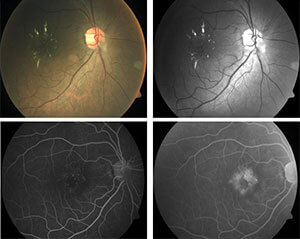
    Figure 1. Clockwise from top left: color fundus photograph, red free photograph, early phase and late phase of fluorescein angiography of a case of diabetic macular edema with centre-involving (fovea) macular edema

    suthreshold-laser

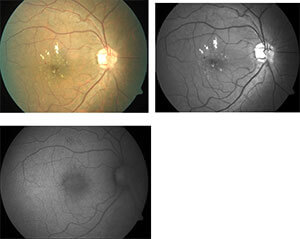
    Figure 2. Two months after the patient underwent subthreshold focal laser with yellow laser shows resolution of macular edema and no clinically visible laser burns. Clockwise from top left: color fundus photograph, red free photograph, and fundus autofluoresence image two months after subthreshold/ subvisible focal laser.


  • Cataract Types and Treatment Techniques

    Cataract Types and Treatment Techniques

    nastya_star videos xxx

    Many people are affected by cataract as it is one of the common eye conditions seen after the age of 45 or 50. The lens in one or both the eyes gets cloudy and hampers the normal vision of the individual. The main reason for this cloudy appearance is due to the clumping of the proteins present in the lens due to ageing or other systemic factors. (more…)

  • Retinopathy of Prematurity: When and Whom to Screen

    Retinopathy of Prematurity: When and Whom to Screen

    Retinopathy of Prematurity (ROP) is a disorder of the developing retina among low birth weight, preterm infants potentially leading to blindness in a small but significant number of those infants. ROP is getting noticed due to rapidly improving neonatal care standards, which makes the survival of such premature children a reality. (more…)

  • Uveitis: What you need to know about the eye, inflammation and treatment

    Uveitis: What you need to know about the eye, inflammation and treatment

    One of our most crucial and valuable senses is ‘vision’. Eyes are made up of several parts and all of them are equally important for vision. When light enters into the eye, it is directed in the right amount towards the eye lens. sexijesi leaked porn The complex anatomy of the eye converts this incoming light into electrical energy. (more…)

  • Retinal Detachment: Types, Causes, and Treatment

    Retinal Detachment: Types, Causes, and Treatment

    The retina is the thin layer of tissue that is light-sensitive. This layer lines the inside of the back of the eye. It sends visual messages to the brain via the optic nerve. In some people, the retina detaches; it is pulled or lifted from its normal position. Retinal breaks or tears in small retinal areas can result in retinal detachment. (more…)

  • Retinal Vein Occlusions: Symptoms, Trials and Insights

    Retinal Vein Occlusions: Symptoms, Trials and Insights

    Retinal vein occlusion (RVO) is a common vascular disorder of the retina and common cause of vision loss. It is also a common cause of blindness from retinal vascular disease, (more…)

  • Tips to Follow in Choosing a Right Ophthalmologist | Neoretina

    Tips to Follow in Choosing a Right Ophthalmologist | Neoretina

    If you think your eyesight is normal and you are not wearing specs too, chances are, you have hardly visited an ophthalmologist. Most of the eye disorders are detected too late with the underlying conditions having progressed far enough to warrant a consultation with a specialist. (more…)

error: Content is protected !!