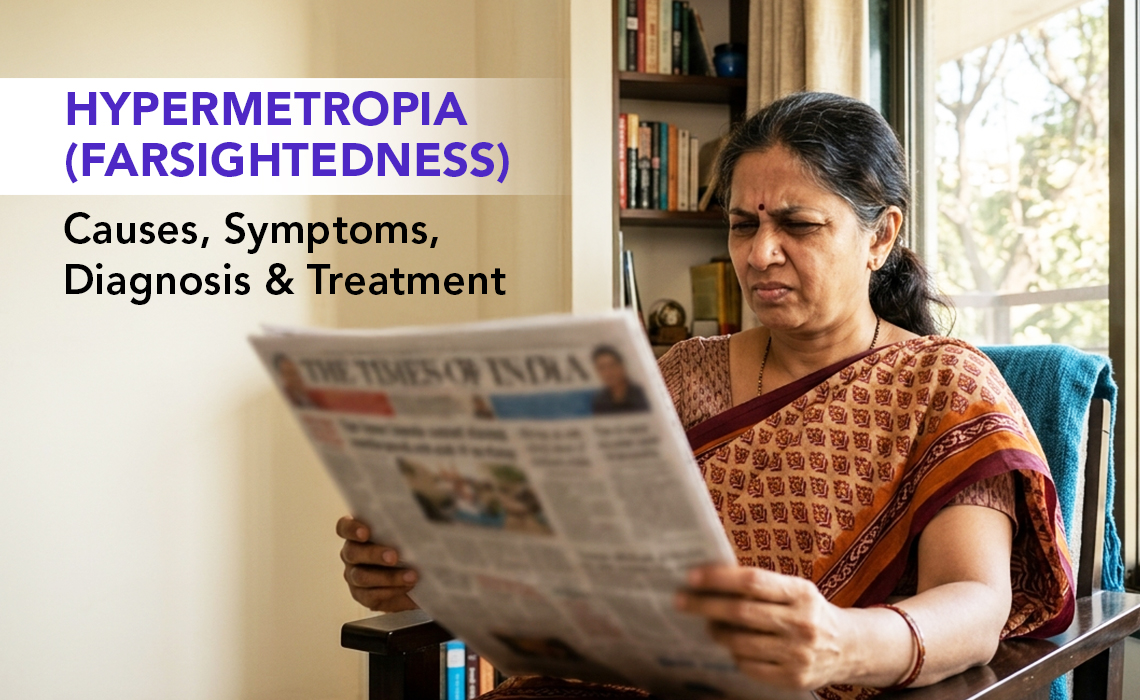
Sight plays an important role in our daily routine, and any problem you have with focusing can make life a lot more complicated while reading, writing, or using any digital device. Hypermetropia (farsightedness/hyperopia) is a refractive error where far-off objects can be seen clearly and near ones appear blurred.
Hyperopia, or farsightedness, is an eye condition in which light entering the eye is focused behind rather than directly on the retina. Having a knowledge of the cause of hypermetropia can be beneficial for symptom management, and with prompt diagnosis and management one might enjoy the reward of clear comfortable vision.
What is hypermetropia (farsightedness)?
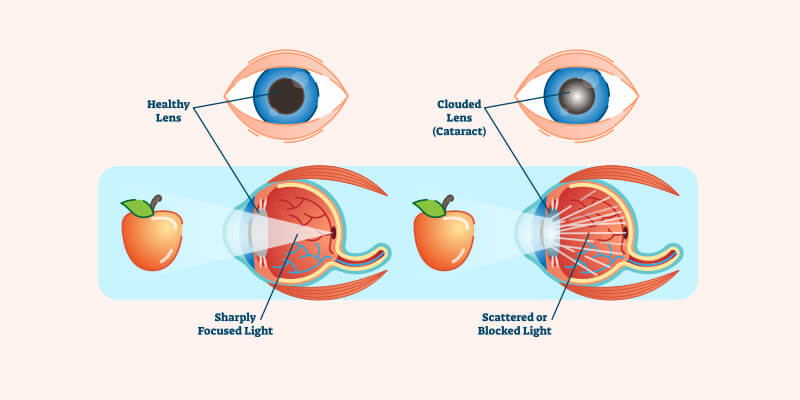
Hypermetropia refers to a refractive error when eye fails to focus on near object. In a normal eye, light rays enter and converge directly on the retina, creating clear vision. Whereas in hypermetropia, rays meet behind the retina, which means that close objects appear fuzzy and distant items may be seen better.
This condition usually occurs When the eyeball is too short or the curvature of the cornea is less. A lot of people are born mildly hyperopic and don’t have symptoms early in life, as the eye muscles can adapt to the focusing problem.
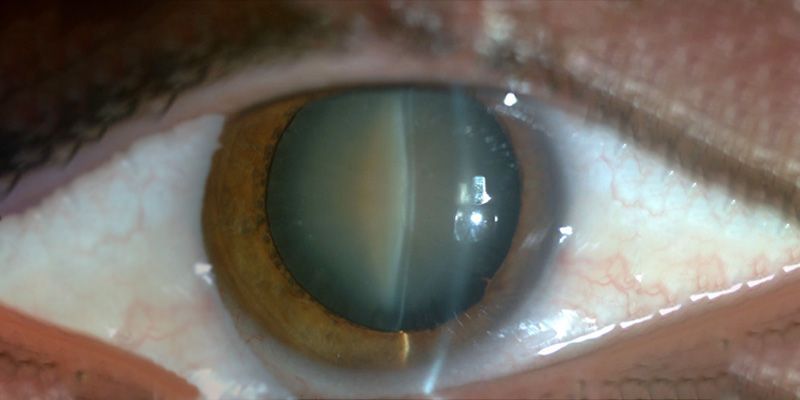
Clinically, hypermetropes with age-related nuclear cataract can have their hypermetropic spectacle prescription reduced by a myopic shift. Patients may feel their vision is improving because they need weaker glasses, but that doesn’t mean the problem with vision has gone away.” Instead, it may be a sign of cataract changes in the eye and should be evaluated.
Causes of Hypermetropia
Several structural and physiological factors can lead to hypermetropia.
Short Eyeball
If the eyeball is shorter than normal from front to back, light rays converge behind the retina rather than directly on it.
Flat Cornea
When the cornea is not as curved as normal, it fails to bend light appropriately, leading to farsightedness.
Lens Position or Shape
Changes in the lens structure can affect how light is focused inside the eye.
Genetic Factors
Hypermetropia can be hereditary, so children might inherit the condition from their parents.
Hypermetropia
Symptoms of hypermetropia can vary with the severity of the condition and the individual’s age.
Blurred Vision for Near Objects
It may be difficult to read books, use a phone, or perform close tasks.
Eye Strain
Eyelids and eyeballs also get tired because forced attention to something rarely comes with the same easy state of mind as flowing awareness.
Frequent Headaches
Headaches can develop after prolonged periods of reading or working on digital screens.
Difficulty with Close Work
Activities such as sewing, writing, or other fine movements can become painful.
Burning or Watery Eyes
Some people may experience eyestrain or watering after extended near-work.
Symptoms in Different Age Groups
Children
Common complaints with hypermetropia are difficulty in reading concentrating, rubbing of eyes frequently and headache. In some cases, uncorrected hypermetropia can hinder learning or school performance.
Adults
The most common complaints eye doctors hear from patients are those of adult near vision becoming blurry, eye strain after many hours on any one electronic screen, or headaches resulting from reading for a long period of time or performing close-focus work tasks.
Diagnosis and Tests of Hypermetropia
Early diagnosis of hypermetropia helps in managing the condition effectively. Eye specialists perform several tests to identify farsightedness.
Visual Acuity Test
It uses an eye chart to measure how clearly a person can see objects further away and up close.
Retinoscopy
Retinoscopy is the test in which light is projected into the eye and then focused on observation of how light reflects from the retina to estimate refractive error.
Refraction Test
Different lenses are used to tell which prescription is needed to fix any errors in vision.
These tests are essential for confirming that hyperopia is present and to identify what the corrective needs are preoperatively.
Hypermetropia (Farsightedness) Management and Treatment
Some treatment modalities for Hypermetropia may also depend on the severity of condition as per the patient’s age, the overall health or condition of eyes, but generally eyeglasses with convex lenses are used.
Eyeglasses and Contact Lenses
Most frequently, hypermetropia treatment involves corrective lenses. Convex lenses ensure that light is focused properly on the retina, improving near vision.
Refractive Surgeries
Some patients elect for refractive surgery to permanently change the corneal shape and correct the refractive error.
Lifestyle Adjustments and Eye Exercises
Good habits (enough light, limited near-work screen time, breaks from near-work) can help limit eye strain. Even by themselves, these designs greatly improve visual comfort and eye health in cases of hypermetropia they do not entirely remove.
Patients with hypermetropia should also have regular eye checkups. As stated previously, age-related nuclear cataract potentially induces a decrease in hypermetropic spectacles prescription from myopic shift, which can create a fallacy of correction of vision. So, these changes need to be detected early with professional evaluation.
Conclusion
Hypermetropia (hyperopia) is a general eye problem that causes difficulty in seeing nearby things. Hypermetropia causes hyper metropia symptoms and timely diagnosis of hypermetropia. Corrective options — glasses, contact lenses or (refractive) surgery — can work miracles for vision and daily comfort.
And just because a hyperope suddenly requires less power in their glasses, don’t assume they are growing better eyesight. Although an age-related nuclear cataract can induce a hyperopic shift that may seem to decrease the amount of hypermetropia necessary.
Routine-eye exams and timely detection allow appropriate monitoring and protection of long-term eye health. A visit to experienced eye specialists at Neoretina can confirm whether it is a genuine case, leading to the right treatment so that you can remain blessed with a clear and healthy vision.
FAQ’s

- LASIK vs SMILE vs ICL: Which Eye Surgery Is Best for You - September 30, 2026
- Blurred Vision: Causes and When to Worry - September 10, 2026
- Stye vs Chalazion: Causes, Treatment, and Home Care - September 10, 2026